
Posted on Leave a comment

Indus Valley Secrets: Rise of a lost Empire

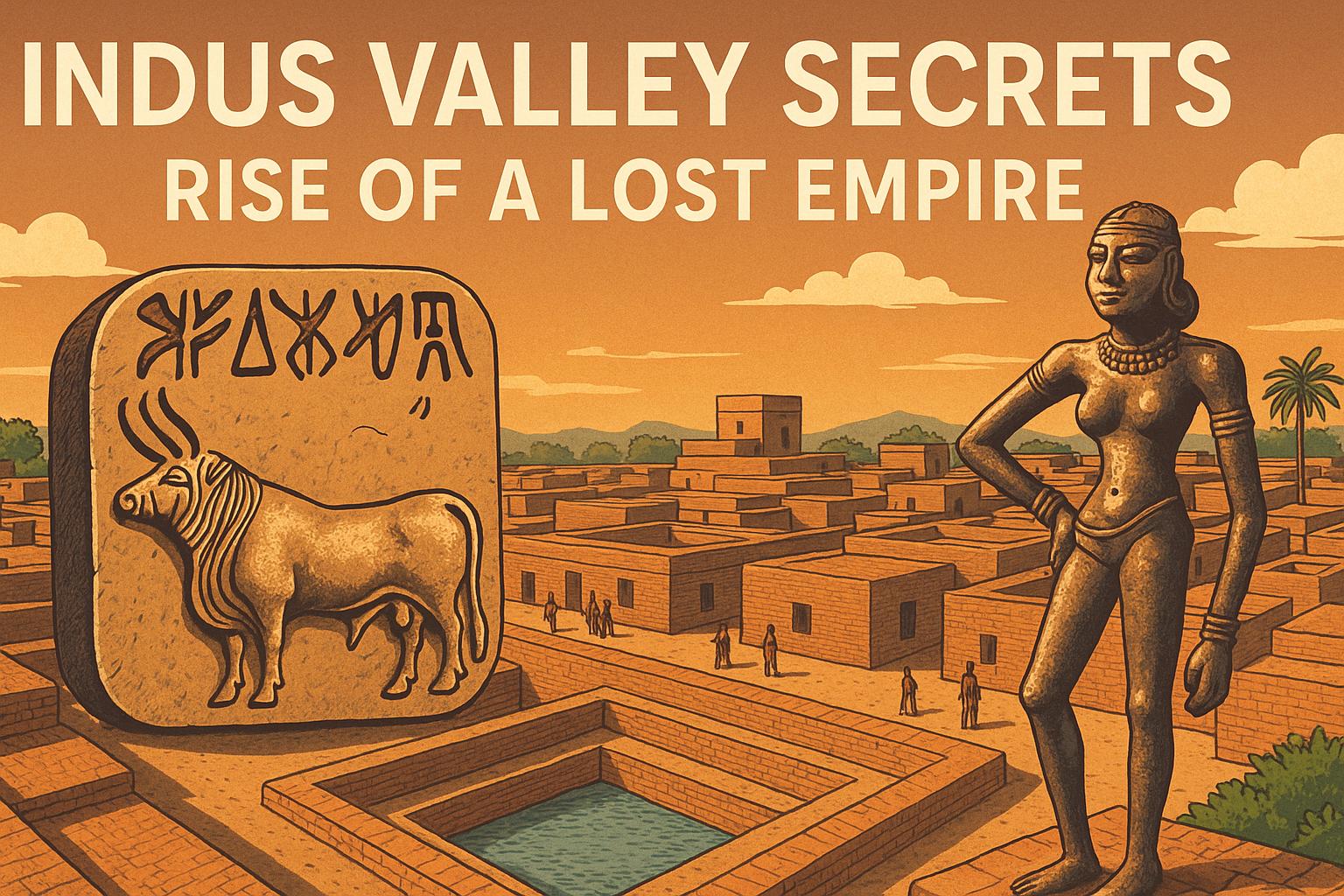
Illustration of the Indus Valley Civilisation featuring ancient city structures, a large stone seal with a bull and script, the Dancing Girl bronze statue, and people walking near the Great Bath under a warm sunset sky.

Introduction

The Indus Valley stands not just as an archaeological wonder but as a symbol of human resilience, innovation, and silent brilliance. Located in present-day Pakistan and northwest India, this ancient civilization flourished nearly 5,000 years ago, leaving behind a legacy that continues to fascinate historians, archaeologists, and dreamers alike.

Unlike many ancient empires that crumbled due to conquest or chaos, the Indus Valley tells a quieter story—one of evolution, adaptation, and mystery.

Origin and Expansion Of Indus Valley

The Indus Valley civilization began around 3300 BCE in the fertile plains of the Indus River. With its advanced urban planning, clean water supply, and organized trade networks, it rapidly grew into one of the most powerful societies of its time.

Its major cities—HarappaMohenjo-daro, and Dholavira—weren’t just population hubs. They were planned powerhouses, equipped with public baths, complex drainage systems, and standardized bricks that showed remarkable engineering consistency.


Culture and Society

Despite lacking grand monuments or flashy empires, the Indus Valley had a culture rich in emotional depth and social harmony. Archaeological findings suggest they lived in a peaceful and egalitarian society. Weapons were rare, and artistic expressions were abundant—seen in seals, pottery, figurines, and jewelry.

From their script etched in symbols to delicate craftsmanship in bead-making, every artifact whispers a tale of creative brilliance and silent resilience.


Trade and Innovation in Indus Valley

The Indus Valley didn’t survive on isolation. It thrived through vibrant trade networks that connected it to distant Mesopotamia and the Persian Gulf. Goods like lapis lazuli, copper, ivory, and textiles were exchanged with pride and precision.

Their measurement systems, weights, and seals show a deep understanding of mathematics and administration—far ahead of their time.


Mysterious Decline

Perhaps the most emotionally gripping chapter in the story of the Indus Valley is its unexplained decline around 1900 BCE. Unlike dramatic collapses seen in other civilizations, the Indus Valley faded away silently.
Theories suggest climate change, shifting rivers, or even tectonic activity may have forced its peaceful people to migrate. But no one knows for sure.
The absence of war or destruction adds a haunting power to its end—like a candle that quietly extinguished.


Legacy and Rediscovery of Indus Valley

Though lost for millennia, the Indus Valley was rediscovered in the 1920s, reshaping our understanding of ancient history. Its planned cities, water management systems, and social structures continue to inspire modern architects, historians, and thinkers.

This legacy reminds us that power does not always roar—sometimes, it whispers through time, waiting to be heard by those who dare to listen.


Conclusion

The Indus Valley is more than ruins and relics. It is a testament to human brilliance, a legacy of peace, and a chapter of history that refuses to be forgotten. As we unearth more, we rediscover not just an ancient civilisation—but our own roots of innovation, harmony, and silent strength.

ALSO READ ABOUT CHANTAL TROPICAL STORM
 

Posted on Leave a comment

Silk Route: Uncovering the Secrets That Shaped the World

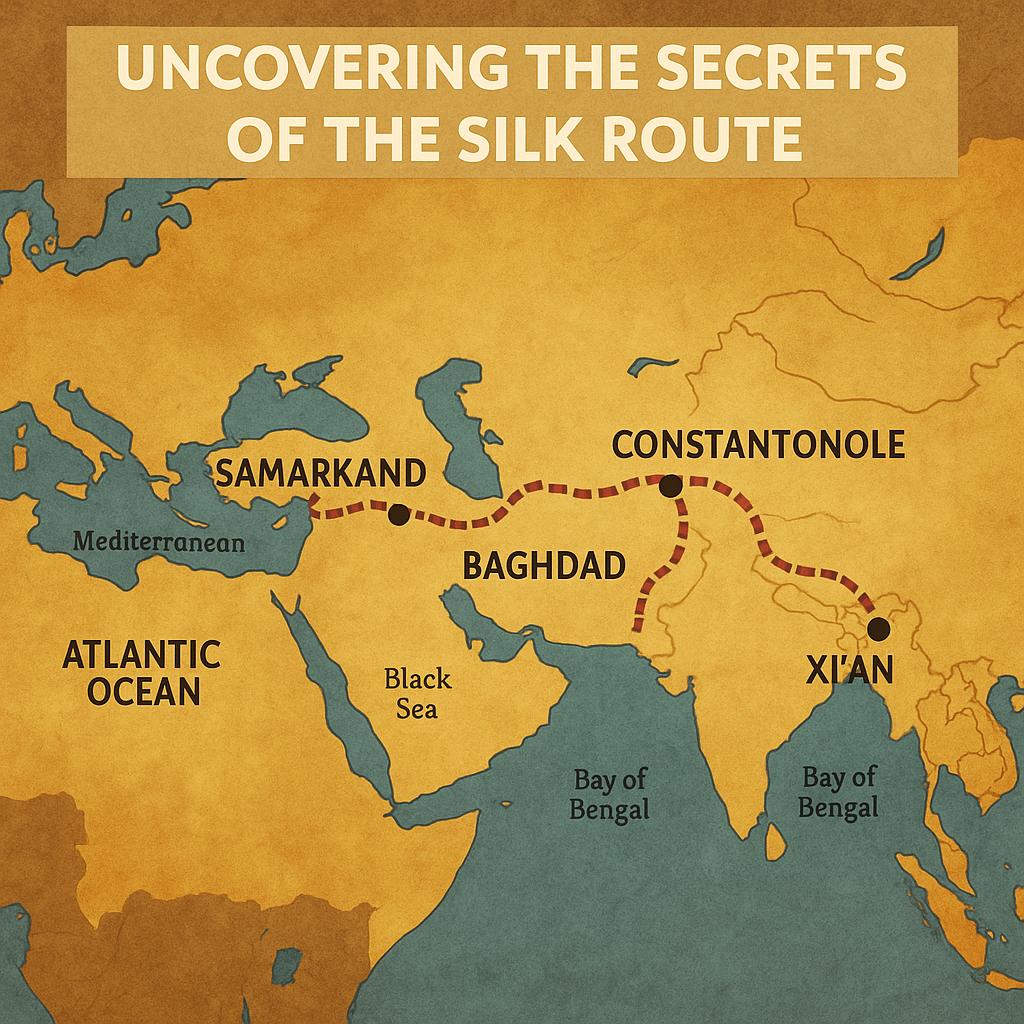
Vintage-style map showing the ancient Silk Route from Xi’an in China to Constantinople, passing through key trade cities like Samarkand and Baghdad, with a red dashed line marking the overland trade path.

The silk route —often referred to as the Silk Road—was not just a single path but a vast network of interconnected trade routes. Spanning thousands of kilometers across Asia, the Middle East, and Europe, it played a monumental role in shaping global history. It connected the East and West through commerce, culture, religion, and diplomacy, serving as the backbone of international trade for over 1,500 years.

Vintage-style map showing the ancient Silk Route from Xi’an in China to Constantinople, passing through key trade cities like Samarkand and Baghdad, with a red dashed line marking the overland trade path.

Origin of the Silk Route

The Silk Route began during the Han Dynasty of China around 130 BCE. Initially, it was a diplomatic initiative to establish connections with Central Asia. However, it quickly evolved into a vibrant commercial highway. The name “Silk Route” comes from the lucrative trade in Chinese silk, a product highly prized in the West.

Silk wasn’t the only commodity traded. Spices, porcelain, tea, precious stones, and paper also moved westward, while horses, wool, glassware, and gold traveled eastward.


Main Trade Routes of the Silk Route

The Route was divided into two primary corridors:

1. The Land Route

This path extended from Xi’an (China) to Antioch (Syria) and further into Europe. It passed through:

  • The Taklamakan Desert
  • Samarkand and Bukhara (in modern-day Uzbekistan)
  • Persian cities like Merv and Nishapur
  • The Middle East, connecting to the Mediterranean ports

2. The Maritime Silk Route

This seaborne version linked South ChinaIndia, and Sri Lanka with Arabia and East Africa, eventually reaching Europe through the Red Sea and Alexandria.


Cultural Exchange Along the Silk Route

While trade was the initial purpose, the Route became a powerful catalyst for cultural diffusion. With merchants came religions like Buddhism, Islam, and Christianity. Art, music, literature, and scientific knowledge also flowed freely between civilizations.

One of the most influential outcomes of the Silk Route was the spread of Buddhism from India to China and Japan. Simultaneously, Chinese inventions such as gunpowder, papermaking, and printing spread westward, transforming societies.


Silk Route and the Rise of Great Cities

Several legendary cities flourished due to the this route:

  • Samarkand: A melting pot of Persian, Indian, and Chinese cultures
  • Kashgar: A crucial hub in Xinjiang for travelers crossing deserts
  • Constantinople (Istanbul): The gateway between Asia and Europe
  • Baghdad: A center of Islamic scholarship and innovation

These cities thrived as trade centers and became the heart of empires and sultanates.


The Decline of the Silk Route

Despite its success, the Route eventually declined in the 15th century, mainly due to:

  • The rise of maritime trade routes by European powers
  • The fall of the Mongol Empire, which had safeguarded overland trade
  • Political instability and invasions, which made the route dangerous

As ships began to dominate global commerce, the overland Silk Route faded into history—but its legacy remained.


The Silk Route Today: A Legacy Reimagined

In recent decades, the Silk Route has gained renewed interest. China’s Belt and Road Initiative (BRI) aims to revive this ancient trade path through modern infrastructure and economic collaboration, connecting over 60 countries under one economic corridor.

Tourism, heritage conservation, and academic research are also breathing new life into Silk Route history, allowing people to rediscover its cultural richness.


Why the Route Still Matters

The Silk Route symbolizes much more than trade. It was the first global highway, enabling dialogue between empires, innovations in technology, and unity in diversity. In a world increasingly divided, the Route reminds us that connection, exchange, and cooperation are the true drivers of human progress.


📌 Quick Facts About the Route

Aspect Details
Origin Han Dynasty, China (~130 BCE)
Length Over 7,000 km (land and sea combined)
Peak Use 1st century BCE to 15th century CE
Key Cities Xi’an, Samarkand, Baghdad, Constantinople
Major Commodities Silk, spices, paper, glass, horses, gold
Legacy Global trade, cultural exchange, religious spread

Conclusion

The Silk Route was more than a trade network—it was a global connector long before globalization. Its story offers lessons in diplomacy, diversity, and interdependence that are still relevant today.

Whether you’re a history enthusiast, a cultural researcher, or a curious traveler, exploring the this Route reveals the powerful ways the past continues to shape the present.

READ MORE ON HISTORY